
About Deanalytics
From employee ownership, for employee ownership.
Aaron Dean started in the trades and joined Markertek in 2013. Markertek was a division of Tower Products — a family-held manufacturer when he arrived, and a 100% employee-owned company by 2016. He built its data practice from the inside, earned an MBA while doing it, and started Deanalytics to serve ESOPs the way someone who has lived inside the conversion would.

The story.
Years before Markertek, I worked with my hands. Solar electrical, contract work, whatever the day needed — the kind of trades where problem-solving is a physical act. The instinct to open the panel and find out which wire actually matters. That instinct did not transfer cleanly to the work I do now, but it transferred more than people expect.

What ended the trades chapter was almost getting blown off a roof. After a close call like that, the questions you'd been avoiding start asking themselves back. I went skydiving with friends — which is, in retrospect, an unusual response to a near-death experience and also the one I had. Somewhere in the free-fall I recognized the thing I'd been avoiding: I had a skillset I wanted to use and a technical mind I wanted to challenge. I showed up at Markertek Video Supply's door and asked for a job.
They hired me. That was 2013 — my first chapter inside a company rather than on a jobsite. Markertek turned out to be a division of a family-held manufacturer called Tower Products, based upstate. Logistics, operations, inventory, the rhythm of a business that runs on deadlines and moves real product. I was not yet calling what I was doing analytics. I was answering the kind of operational questions that, years later, I would recognize as the questions every operating company has and never asks precisely enough.
In 2016, three years into my time there, Tower Products converted to a 100% employee stock ownership plan. Not a partial sale, not a gradual transfer — a full conversion, where every employee became a partial owner of the thing they were working on. Me included. That conversion is the hinge of this whole story. An owner is not a different employee. An owner asks different questions of the same numbers. The company had not formally hired me to build a data practice. I started building one anyway, because the employees around me were now owners, and owners needed to see things they could not yet see.
I went back to school for an MBA while I was doing it. Nights and weekends. I learned the analytical vocabulary for the things I had already been doing on instinct. Student loans and a full-time job — the period that taught me why the phrase skin in the game is not a cap-table footnote. The MBA did not invent the data practice at Tower. It named it. It gave me a way to explain to the next company why the reporting they thought they had was not the reporting they actually had.
I left Tower in 2018 to work in analytics full-time. The practice runs on statistical modeling and machine learning as much as on dashboards — a decade of the discipline, applied wherever the business actually needs to see. By 2019 the work had narrowed toward employee-owned companies — first inside a larger operation, and eventually as Deanalytics. The firm exists for one reason: ESOPs are different, and the data work that serves them has to be built by someone who knows the difference from the inside. A consultant who's never been an employee-owner can deliver a good dashboard. They will miss what the dashboard is for.
Philosophy.
Deanalytics runs on a Quaker discipline: ask more than you answer. That isn't a brand tic — it's how the best engagements work. A consultancy that arrives with answers is selling a deck. A practice that arrives with questions helps a leadership team name what it already half-knows. Every engagement begins with a question, and most of our framework names are questions we kept asking until the question became the answer.
The tradition runs deeper than the question-asking. Quaker business practice treats plain speech as a discipline — the same language in a boardroom, an email, and a report — and it treats truth-telling as non-negotiable. In a data practice that has a specific meaning: the numbers get to say what they say, even when it's not what anyone hoped to hear. Employee-owners can smell consulting jargon from fifty feet, and a report that flatters is a report that failed.
Stewardship it treats as a time horizon, not a line on a values page — and that one matches the shape of an ESOP exactly. The people running the company now are holding it for the people who will own it in thirty years. The data work should be built to that horizon, not a quarterly cycle.
I don't write this as marketing. I'm a member of the Religious Society of Friends — it's where I learned that a business answers to the people it touches, and that owning your work is a kind of dignity. It's no accident I've spent a decade on employee ownership.
Practice.
10
Years in data analytics.
10
Years in employee ownership.
Domo
Major Partner. Certifications in Professional Services and Technical Services.
MBA
Completed while working full-time at the company that taught me ownership.
A decade of production analytics across operations, finance, manufacturing, and customer data — forecasting, anomaly detection, retention modeling, segmentation, dashboard systems, statistical modeling, and machine-learning work where the business case calls for it. The domains change; the underlying discipline is what carries from one engagement to the next.
Standing in the field
The company we keep.
The organizations Deanalytics works with, each with a short factual line about the work.
Employee-ownership institutions

EOX
Employee Ownership Expansion Network. Partner on outreach analytics and operational data work; ongoing engagement.

MICEO
Michigan Center for Employee Ownership. Featured partner; data and dashboard work referenced in a MICEO feature article.

GACEO
Georgia Center for Employee Ownership. Partner; the free ESOP Scanner and state-center data resources shared with the GACEO network.
NCEOC
North Carolina Employee Ownership Center. Advisory on data analytics and outreach, 2026.
Research collaborations
Rutgers Institute for the Study of Employee Ownership and Profit Sharing
Deanalytics is collaborating with researchers at the Rutgers Institute for the Study of Employee Ownership and Profit Sharing on a series of analyses of employee ownership using IRS Form 5500 and related data. The pieces are co-authored with Matt Mazewski, Ph.D., Research Associate and Economist at the Institute, for publication through the Institute’s Employee Ownership Research-to-Practice Hub. Deanalytics provides the underlying data extracts and documentation. First piece planned for fall 2026.
About the collaboration →Terminated ESOP Distribution Data Study — with EOX
A Kelso Fellows research project (Rutgers Institute for the Study of Employee Ownership and Profit Sharing), co-authored with Steve Storkan, Executive Director of EOX. Presented at the Kelso Workshop and made available as a research resource for state centers and emerging ESOP boards.
Read about the study →Community
Tech-Moms
A nonprofit training women for careers in tech. Deanalytics hired one of their data analytics graduates; partnership ongoing.
Deanalytics has been an incredible partner to the Tech-Moms program, showing a genuine commitment to supporting our students. They’ve gone beyond collaboration by creating real opportunities, most notably hiring one of our data analytics graduates, which speaks volumes about their belief in our mission. We’re grateful for their partnership and the meaningful impact they’ve made in helping women launch careers in data.
— Alyson La, Data & AI Educator, Tech-Moms
Affiliations are descriptive. None of the organizations listed endorses Deanalytics or its services.
What partners say.
ESOP mission
Aaron understands employee ownership deeply, as working for an employee-owned company changed the trajectory of his own life.
ESOP mission
They took the time to understand our mission and challenges, helping us identify high-potential prospects and streamline outreach. By intelligently organizing data, they saved us countless hours and uncovered high-value opportunities.
How we work
We had a data-driven vision — Aaron helped us build a culture of self-service analytics that grew with the business.
Press, features, and speaking.
Featured in MICEO's spotlight
"Aaron Dean: The Game-Changer in ESOP Data"
"No one else in the world focuses exclusively on employee-owned data the way Aaron does."
Read the article →Speaking
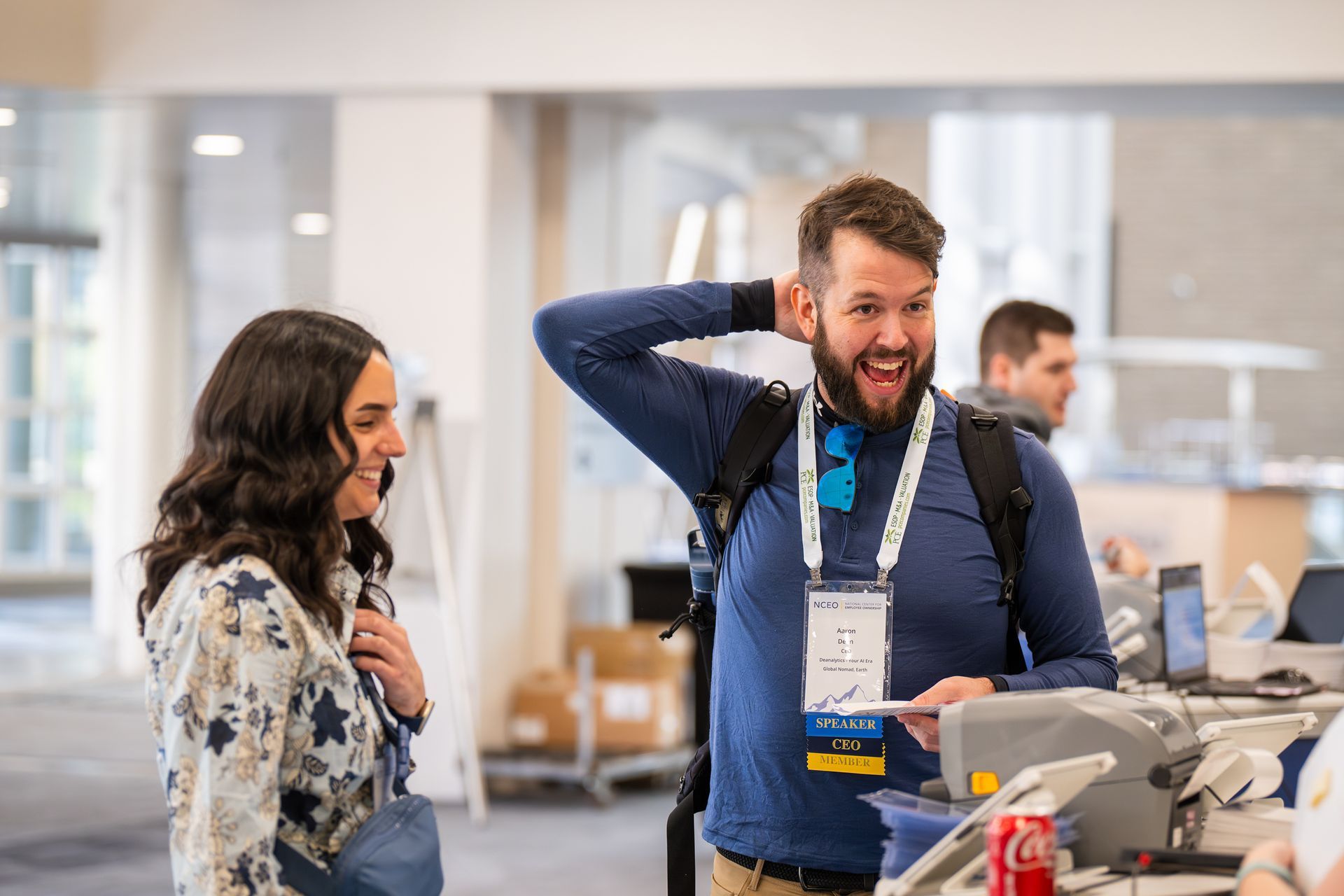
Spoke at NCEO twice in 2025 — the Annual Employee Ownership Conference (Milwaukee, April 15) and the Fall Forum (Philadelphia, August 27–29). Full talk history on Research & Writing.
What would it mean for your firm to work with someone who has actually lived, not just studied, what employee ownership feels like on a Monday morning?